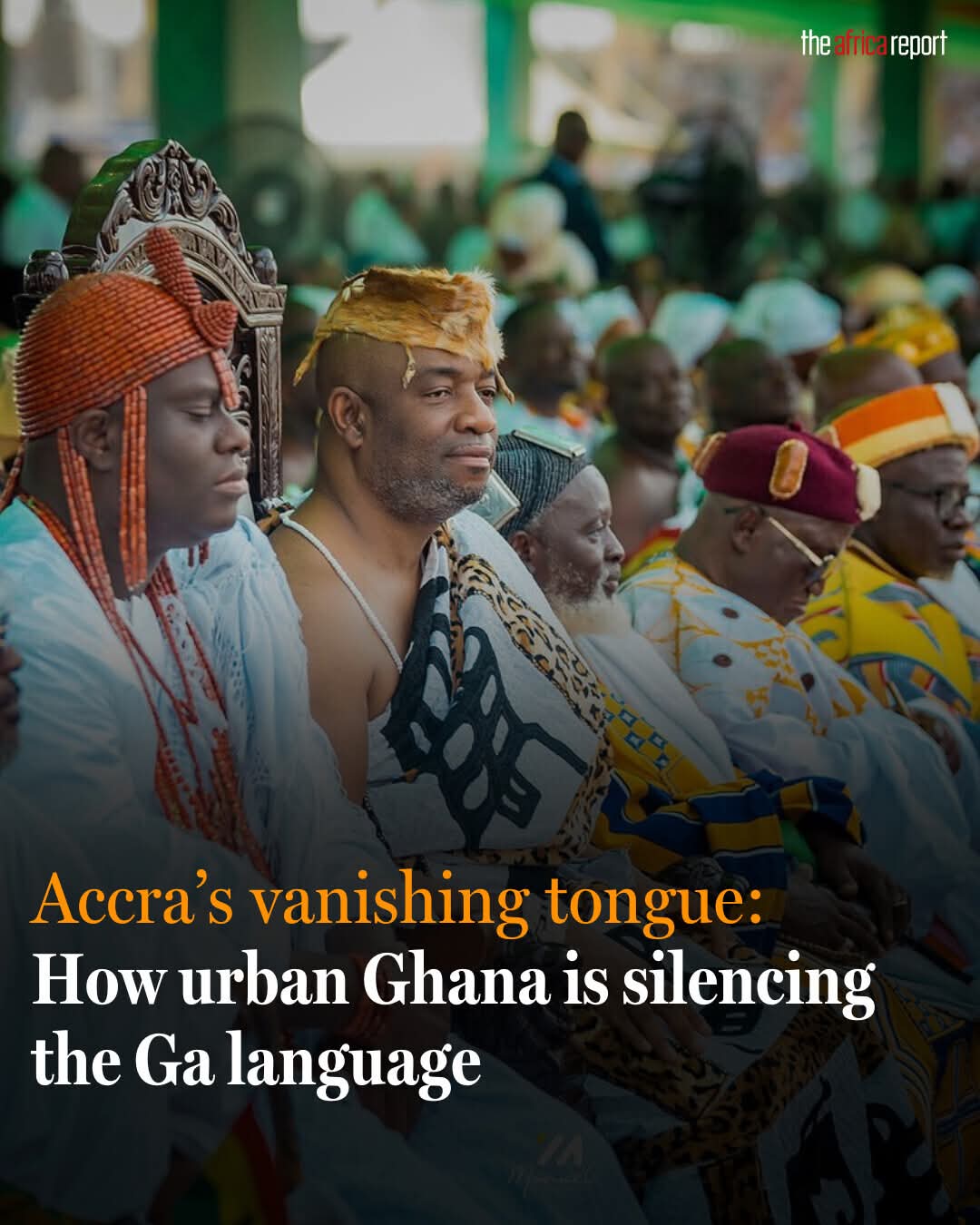
As Accra grows more cosmopolitan, the indigenous language of its founders is fading from daily life. For the Ga people, this linguistic decline signals something deeper than change.
From the air, Accra unfurls as a restless sprawl of concrete, coastline and colour. Glass-fronted banks and diplomatic missions sit just minutes from canoe-lined beaches, where fishing nets dry under the sun in Jamestown, Chorkor and La.
The Atlantic still dictates the rhythm of life along these indigenous coastal settlements, even as traffic-clogged highways pull the city inland towards its booming suburbs.
Yet beneath the energy of Ghana’s capital lies a quieter crisis: the steady disappearance of Ga, the language of the people who first settled and shaped Accra.
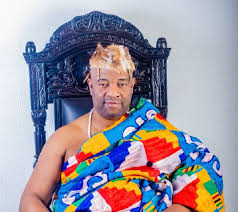
“A people without their language are like a house without a foundation,” says King Tackie Teiko Tsuru II, the overlord of Accra.
“If we lose Ga, we lose memory, Accra must not forget who it is.”
Accra is proudly cosmopolitan. It is home to traders from Kumasi, fishermen from the Volta coast, migrants from northern Ghana and a growing expatriate community.
Twi, widely spoken by Akan migrants – notably from the Ashanti Region – has become the city’s dominant Ghanaian language, alongside English.
In markets, churches, offices and taxis, Twi increasingly functions as an unofficial second national language.
For the Ga people, however, this linguistic success story feels like displacement.
Pathway to language extinction
In many private schools across the Greater Accra Region, Twi is taught as the sole Ghanaian language, sidelining Ga despite being the indigenous tongue of the capital.
Ga-speaking children often find themselves learning Twi as a “local language” in their own homeland, while their mother tongue slips into disuse at home and in public spaces.
“Urbanisation didn’t just bring buildings; it brought” Accra-based cultural advocate Jeffery Tetteh tells The Africa Report.
“Ga children are being socialised into believing their language is optional, while Twi is essential for survival.”
Linguists warn that such dynamics are a classic pathway to language extinction. When a language loses prestige and institutional support – especially in education – it rapidly retreats from everyday use.
The Ga situation echoes broader African trends. In Kenya, minority languages such as Elmolo are critically endangered.
In Nigeria, UNESCO lists dozens of indigenous languages at risk as urban youth adopt dominant tongues.
South Africa, despite recognising 11 official languages, still grapples with uneven use and preservation.
If we lose Ga, we lose memory, values and identity. Accra must not forget who it is
Accra’s crisis, however, is uniquely symbolic: it is unfolding in the political and diplomatic heart of the nation.
Now, a cultural pushback is gathering momentum.
King Tackie Teiko Tsuru II has directed that from the next academic year, all basic and junior high schools in Greater Accra must teach Ga and Dangme as compulsory subjects. He frames the move as a matter of cultural survival, not sentimentality.
“This is not about resisting diversity,” the king tells The Africa Report through a spokesperson.
“It is about ensuring that the language of this land stands confidently among others. Ga must live – not as folklore, but as a working language.”
Youth groups have amplified the call. Jeffery Tetteh, who is also the spokesperson for the La Youth Association, argues that the dominance of Twi has gone unchecked for too long.
“Twi is important, but it must not overpower everything else,” he says.
“Accra is Ga-Adangme land. When our language disappears, our festivals, customs and even our worldview follow.”
Shift in culture
Those cultural shifts are already visible. Traditional Ga marriage rites and funeral observances – once modest and ritual-driven – are increasingly adopting Akan styles, marked by elaborate pageantry and Twi-speaking officiants.
A people without their language are like a house without a foundation
For many Ga elders, the changes feel less like evolution and more like erasure.
Public symbolism has become another battleground. At Kotoka International Airport, millions of visitors are greeted by the Twi word
Ga advocates want Oobakɛ – the Ga welcome – displayed with equal prominence.
Similar complaints surround the Kwame Nkrumah Mausoleum, where Twi and Ewe greetings appear, but Ga is absent.
Greater Accra regional minister Linda Akweley Ocloo has publicly backed broader language inclusion.
“Greater Accra is not just a capital; it is Ga-Adangme land,” she tells The Africa Report.
“Cultural respect must be visible. When we acknowledge Oobakɛ, we acknowledge history.”
The city’s mayor, Michael Kpakpo Allotey, has gone further, directing that Oobakɛ be boldly inscribed at the entrances of all basic schools in the metropolis.
“This is about pride,” Allotey says. “When children see their language every day, they understand they belong. Development must not erase identity.”
Communications consultant Randa Naa Dei Ashie of Dream Station Gh. Ltd believes the stakes extend beyond Accra.
“Languages carry economic and social capital,” she says.
“Cities that protect indigenous culture become more attractive, not less. Globalisation rewards authenticity.”
For the Ga people, the fight is urgent but hopeful. Along the coast, fishermen still shout commands in Ga as waves crash against wooden canoes.
Homowo, a festival before the harvest, still takes place to commemorate those who died during a pre-colonial famine in the region. The language still breathes.
Whether it survives Accra’s relentless growth may determine not just the future of a people, but the soul of Ghana’s capital itself
By Kent Mensah for The Africa Report