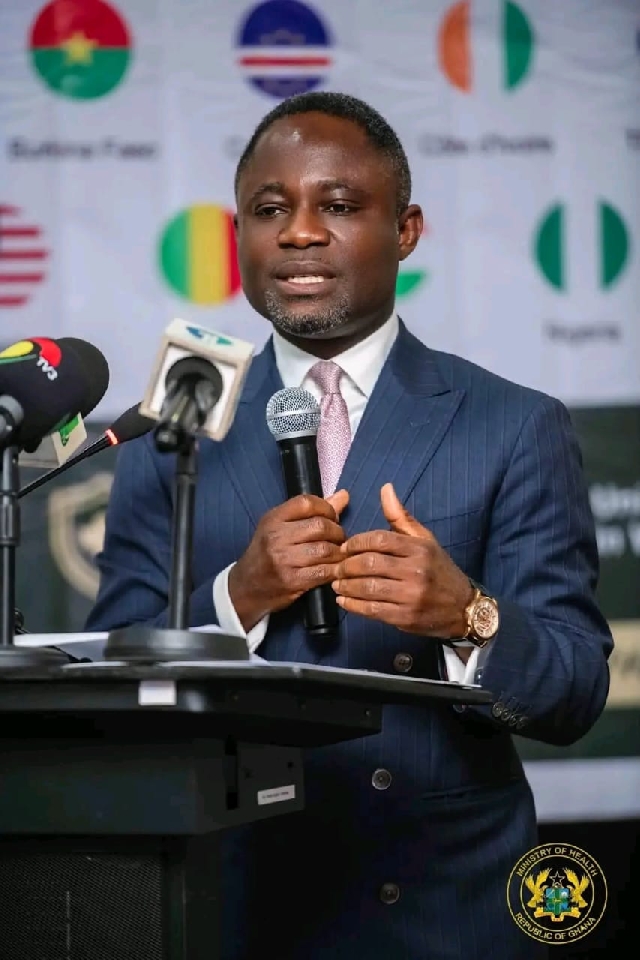
The Minister for Health, Kwabena Mintah Akandoh has charged African medical regulators to make regulation faster, more reachable and relevant to today’s healthcare realities, warning that expanding access without quality could expose people to harm.
Speaking at the opening of the 28th Annual International Conference of the Association of Medical Councils of Africa (AMCOA) in Accra, the Minister said the conference comes at a significant time for Ghana.
“You have come to Accra at an important time. This is the home of the Accra Reset, championed by His Excellency the President…and helping to lead a conversation across Africa and the global south on re-searching the global health architecture from fragmentation towards coherence and from dependency towards greater sovereignty. It is therefore fitting that regulators are meeting here,” he said.
“If we are asking whether the global health architecture remains fit for purpose, we must also ask whether our regulatory architecture remains fit for the societies we now serve,” he added.
The Minister commended AMCOA for 28 years of protecting the African public through quality standards in medical education and practice.
“For 28 years, the association has brought regulators together, advanced standards…and above all, helped protect the African public. Africa says thank you,” he stated.
Explaining the theme “Responsive Regulation for Safer Communities towards Universal Health Coverage”, the Minister said UHC goes beyond free services.
“Universal Health Coverage simply means that somebody can enter a health facility…It must also mean that a person providing that service is properly trained, competent, appropriately licensed, practicing within defined standards, and has the tools required to deliver safe care.”
“Every clinic we open, every service we make free, and every additional person to whom we extend health care is a promise to our countrymen and women. Good regulation helps us deliver on that promise. After all, access without quality is incomplete, and coverage without competence can expose people to harm,” he stressed.
He called for regulation that is responsive in four ways stating “responsive in speed, because we cannot take months to verify a qualification when a district hospital urgently needs a doctor. Responsive in reach, because citizens should be able to easily establish whether the person treating them is properly licensed. Responsive in relevance, because complaints must be investigated and resolved fairly. And responsive in scope, because we must regulate the health care people receive today, not the health care of 20 years ago”.
On the workforce, Mr. Akandoh revealed that Africa’s health workforce grew from 4.3 million in 2019 to 5.72 million in 2024, producing more than 325,000 graduates annually, yet the continent still has only about 46% of the workforce it needs while almost 943,000 trained health workers were unemployed between 2020-2024.
“That tells us that our challenge is not simply one of numbers. It is one of planning, financing, training, deployment, retention, and regulation”.
He added that two major meetings in Accra this year—the Second African Health Workforce Investment Forum and Ghana’s Annual Health Summit—reinforced the call to plan, train, retain.
“I believe this conference should add a fourth imperative. Plan, train, retain, and regulate well.”
The Minister said President John Mahama’s government is committed to its side of the compact investing in competence.
“We cannot regulate for competence without investing in competence, and we cannot demand high standards without creating the conditions in which professionals can meet those standards,” he said.
He listed government commitments including decentralizing specialist training, expanding postgraduate opportunities closer to where services are needed, strengthening competency-based training, and ensuring practitioners have the infrastructure and equipment to practice to expected standards.
“Because a competent doctor without functioning diagnostics cannot consistently provide the standards of care against which we hold that doctor accountable. Professional accountability must therefore go hand-in-hand with system accountability,” he noted, adding that the “bottom line, the practitioners must remain competent and ethical”.
“The regulator must assure standards and protect the public, and the government must provide the needed environment for good practice.”
The AMCOA 2026 conference, hosted by the Medical and Dental Council of Ghana, has assembled over 350 regulators from across Africa and beyond.
Source:www.classfmonline.com