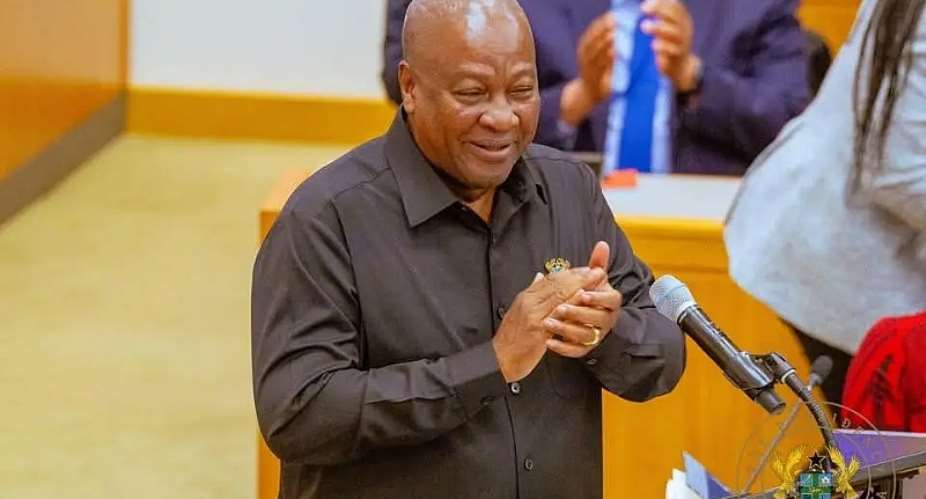
Excellencies, Heads of State and Government,
Distinguished Delegates,
Ladies and Gentlemen.
Truth begins with language, with the power that words hold to shape consciousness, to shift perspective, to propel action.
I therefore offer this truth as a starting point:
There is no such thing as a slave.
There were human beings who were trafficked and then enslaved by people who believed they could own those human beings as chattel, as their personal property.
Some will hear this and think that I am splitting hairs.
“Isn’t that the same thing?” they might ask.
No. It’s not at all the same thing. Not if you acknowledge an individual’s humanity. Not if you respect an individual’s basic right to dignity.
The entire transatlantic slave trade was designed to deny African people their humanity. And that denial was premised on a racial hierarchy with no basis in fact or science, a racial hierarchy that deemed whiteness superior and blackness inferior.
The atrocities that were committed against enslaved Africans, the myriads of injustices that were borne of slavery and carried forward into successive social frameworks, took place specifically because they were considered objects.
So, when discussing slavery and its resulting institutions and practices, we must always start by reclaiming racial equality, the dignity of Africans, the humanity of our ancestors who were enslaved and, as a matter of course, our own humanity.
Recently, someone asked me to explain the importance of the resolution on the declaration of the trafficking of enslaved Africans and racialised chattel enslavement of Africans as the gravest crime against humanity. I responded without pause or hesitation, and I’d like to share with you what I told him.
This resolution allows us, as a global community, to collectively bear witness to the plight of the 18 million men, women, and children whose homes, communities, names, families, hopes, dreams, futures, and lives were stolen from them over the course of four centuries.
I speak these words today not only for Ghana, but also in solidarity with the rest of Africa, the Caribbean, Latin America, the wider Diaspora and, indeed, all people of good conscience throughout the world. This resolution is a pathway to healing and reparative justice. This resolution is a safeguard against forgetting.
Your Excellencies, Ladies and Gentlemen, violence begins with language; when words are used as weapons, or to codify abuse; when people are called out of their names. Regardless of their state of dress when they were captured, enslaved Africans were always stripped of their clothing while being kept in the dungeons of the fortresses that had been built by the Europeans.
They were forced, with their limbs chained and shackled, onto the cargo hold of a ship. They remained naked, packed like sardines, during the months-long journey through the Middle Passage. Not all those who were loaded onto the ships survived the voyage. A number of the ships sank, and many of the enslaved jumped overboard, choosing certain death to captivity. 10 to 15% of enslaved people died in the Middle Passage. Whenever a ship did arrive at its destination, the enslaved people, still naked, were taken to the market, where they were inspected and appraised, like livestock. They were then placed on an auction block in front of an audience of potential buyers and sold to the highest bidder.
Once they were on the plantation where they would work and live, they were stripped of their names. No longer Fatou, Bubakar, Kofi, Nana Yaw, Emeka, Nahnyong or Hamisu, they were given names like Ben, Jemima, Toby, or Mary. In addition to their new name, they were also called “girl,” or “boy,” regardless of how old they were; and there was also—or maybe I should say always— that filthy N-word. If a surname was ever needed, it would be that of their master. Sometimes they were even branded, like cattle, with the plantation’s insignia or logo. There were sugar plantations, but there were also coffee, cotton, tobacco, and cocoa plantations in the Caribbean and the Americas. South America had diamond and gold mines as well. The production of indigo also took place in Jamaica.
The people who were enslaved laboured on those plantations from sunrise to sunset. The conditions under which they worked were brutal. They were beaten, occasionally to the point of death. They were underfed, kept in cramped quarters, and they often died young, if not from the labour then from diseases. Though some enslaved women were turned into breeders, in many of these places, the deaths far outnumbered the births. Let’s not mince words, ladies and gentlemen. Business was booming because when labour is virtually free, profit margins are huge. African lives were disposable. If too many of the enslaved died, more were captured from their homes on the continent, enslaved and trafficked.
During conversations about slavery, this is the point at which euphemisms are introduced, and there’s a rush to talk about abolition. But we can’t afford to look away; this is precisely the part when we should pay close attention
because the devil is in the details. I’m going to share four trafficking destinations with you. Remember when you hear these numbers that this is not data; these are human beings.
Roughly six million enslaved Africans were trafficked to Brazil, which is the fifth largest nation in the world, stretching 4,400 kilometres from north to south and 4,320 kilometres from east to west. Almost 2 million enslaved Africans were trafficked to Jamaica, which was the most profitable of all the sugar-producing locations.
The island is 235 kilometres long and between 34 and 84 kilometres wide, depending on where you’re located. About 500,000 enslaved Africans were trafficked to America. From the early 17th century, when the first ship arrived, to the mid-19th century, when chattel slavery was abolished, America grew from 3 colonies to an independent nation with 36 states. Over 450,000 enslaved Africans were trafficked to Barbados, an island that is 34 kilometres long and 23 kilometres wide. Before the trafficking of enslaved Africans, plantation labour in Barbados came from white indentured servants, who were usually Irish.
There were two major problems with indentured servants: one was that they eventually had to be granted their freedom, and the other was that if they ran away, catching them proved challenging because they were white and could easily blend in. In 1661, Barbados enacted a code for the enslaved. In the preamble, negroes are described as “a heathenish, brutish and uncertain, dangerous kind of people.” It goes on to explain that this is why there must be a set of laws detailing how they should be punished.
Clause Two of the law details what to do if “any negro man or woman shall offer any violence to any Christian as by striking or the like.” It goes on to say that if it is a first offence, the negro should be severely whipped by the Constable. However, if it’s the negro’s second offence, “he shall be severely whipped, his nose slit and be burned in the face.”
This code gave owners and overseers the ability to torture, maim and even kill enslaved Africans with impunity. And it became something of a template for the rest of the Anglo-Atlantic world.
In 1662, a year after Barbados enacted its code, a legal doctrine was established to set judicial, precedent in the American colony of Virginia. It was titled partus sequitur ventrum, which translates from the Latin as “What is born follows the womb.”
This legal framework ensured that all children born of enslaved women would also automatically be enslaved, regardless of who the father was. And it is important to note that many enslaved women were impregnated because they were raped by the plantation owners or overseers. But what this law did, even in the cases where a baby was not the product of rape, was strip the child of its paternity. In the eyes of the law, that child, as an enslaved person, was property that could be given or sold at its owner’s whim. The doctrine was adopted throughout the Americas,
including in Brazil.
People will sometimes try to put a disclaimer on slavery by insisting that you can’t use the social norms of today to judge the actions and events that took place in past eras. Well… they are loud and wrong. Just because everybody is doing something doesn’t make it right. Slavery is wrong now, and it was wrong then. For as long as Africans have been trafficked and enslaved, there have been abolitionists who have spoken up against it. The first slave ship landed in America in 1619. Opposition to chattel slavery was voiced and mentioned in passing in documents, but in 1688, the
Germantown Friends, a group of Quakers, put out a formal, written protest against slavery. In it, they wrote, “Now, though they are black, we cannot conceive there is more liberty to have them slaves as it is to have other white ones. There is a saying, that we shall do to all men like as we will be done ourselves; making no difference of what generation, descent or colour they are.”
Excellencies, Mr Secretary General, erasure begins with language, when words are used as a sleight of hand, to gaslight, to trick you into doubting what you know to be true. It is when words are used to create mythology; when they are spoken, the volume gradually decreases with each repetition until it becomes a full verbal redaction. The legendary American jazz player, Miles Davis, said, “It’s not the notes you play, it’s the notes you don’t play.” When it comes to the contributions that Africa has made to enriching Europe and building the so-called New World, the silence is deafening.
We have paved roads through mountains and put down railroad tracks; we have constructed buildings, laying brick after brick; we have cut sugar cane, picked cotton and cocoa, descended into mines to unearth precious metals and stones; we have wet-nursed babies. We have paid the price of admission with the blood of our ancestors, and still, what greets us at the door is silence. What we are met with is mythology.
In 2015, McGraw-Hill Education, one of the largest publishers in the US, released a geography textbook used in over 1,000 school districts in Texas.
The book stated that millions of workers were brought from Africa to work on agricultural plantations. Workers…not enslaved people. A family complained, and the book was pulled off the shelves. There is a US organisation called Prager U. On the organisation’s website, it’s described as “the world’s leading conservative nonprofit that is focused on changing minds through the creative use of digital media.”
They’ve created animated videos used as supplemental educational material in public school classrooms in 11 states. In one video, a young boy and his teenage sister are confused about why some people celebrate Columbus Day, and others celebrate Indigenous Peoples’ Day. They use a time travel app and find themselves on a ship with Christopher Columbus, who tells them all about how the Carib people, the indigenous people of the Lesser Antilles in the Caribbean, were violent, uncivilised cannibals.
The children then ask him to explain why he’d enslaved people. To that, Christopher Columbus responds: “Slavery is as old as time, and it has taken place in every corner of the world. Being taken as a slave is better than being killed, no? I don’t see the problem.” Columbus then accuses the children of coming to his time and judging him by the standards of their time.”
In another PragerU animated video, the same brother and sister use the time travel app and find themselves in 1852, standing in front of Frederick Douglass. He tells them that he is working to abolish slavery, a system in which people make other people work for long hours with no pay. “The sad fact,” he explains, “is that slavery has existed everywhere in the world for thousands of years.”
In the United States, Black history courses are being removed from school curricula; schools are being mandated to stop teaching students about slavery, segregation, and racism in American history courses. Books about those topics are being banned in schools and public libraries. Museums, art centres, and other institutions whose budgets rely in any way on public funds are being prohibited from scheduling exhibitions and programs, or from displaying materials promoting racial awareness or Black history.
Much like the law that was put in place to regulate the punishment of the enslaved in Barbados, these policies are becoming a template for other governments as well as some private institutions. At the very least, they are slowly normalising the erasure that is taking place. Earlier, when discussing the importance of this resolution, I said it was a safeguard against forgetting. This is the type of forgetting that I was referring to.
There are other types of forgetting as well. The great Jamaican philosopher-poet Robert Nesta Marley famously said, “Emancipate yourself from mental slavery, none but ourselves can free our minds.” I want to repeat an encouragement that I offered at the start of this address, one that is companion to the truth that I began with. When discussing slavery and its resulting institutions and practices, we must always start by reclaiming racial equality, the dignity of Africans, the humanity of our ancestors who were enslaved and, as a matter of course, our own humanity.
We must also remember to reclaim our own humanity, because when we absorb too much of the language of violence and erasure out in the world, we can stop hearing the language of truth that exists within us. When we’re in that state, our minds become enslaved.
In his book, the Guyanese writer Walter Rodney quotes a Dutch traveler’s first impression upon visiting the Nigerian city of Benin: “The town seems very great. When you enter into it, you go into a great broad street… The town is composed of 30 main streets, very straight and 120 feet wide… The houses are close to one another, arranged in good order. These people are in no way inferior to the Dutch as regards cleanliness…”
In 1531, a Portuguese sailor, Viçente Pegado, travelled to the city of Great Zimbabwe, and this is what he wrote: “Among the goldmines and the inland plains between the Limpopo and Zambezi rivers [is a] fortress built of stones of marvellous size, and there appears to be no mortar joining them… This edifice is almost surrounded by hills, upon which are other resembling it in the fashioning of stone and the absence of mortar, and one of them is a tower more than 12 fathoms high.”
A 2016 article in The Guardian highlighted the city of Great Zimbabwe, built between the 11th and 14th centuries. The article described a centuries-old draining system that remained operational, “funnelling water outside the houses and enclosures down into the valley.”
The article also disclosed how “in the 19th century, European visitors to this abandoned medieval city refused to believe that indigenous Africans could have built such an extensive network of monuments.”
Here’s the thing: the greatness that is within us will always outweigh the injustices that have been visited upon us. Our survival is a testament to that fact. In closing, I would like to offer this quote by Nelson Mandela: “Our human compassion binds us the one to the other—not in pity or patronizingly, but as human beings who have learnt how to turn our common suffering into hope for the future.” Truth begins with language.
I hope all of you will vote tomorrow to speak truth to power so that together we can pass this historic resolution and finally acknowledge the full horror of these transgressions against the humanity of the 18 million human beings who were enslaved.
Thank you.
www.modernghana.com