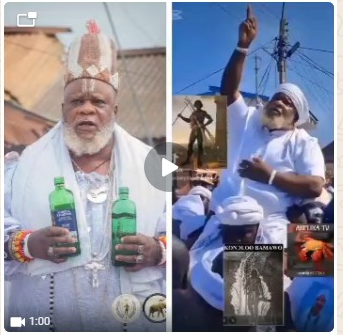
Under the spiritual and political guidance of Gborbu Wulɔmɔ, Nungua is stepping into a historic role: the Mecca of GaDaŋme life. This is not hyperbole, it is a bold declaration that the sacred heart of GaDaŋme civilization now beats in Nungua. Here, priestly authority, ancestral rites, and council deliberations converge, creating a central hub of ritual and political power.
Nungua is no longer just a town; it is the symbolic and functional center where GaDaŋme identity is enacted and reinforced. Just as Mecca unites millions under faith, Nungua is uniting the GaDaŋme under the continuum of tradition, seniority, and spiritual legitimacy. Under Gborbu Wulɔmɔ’s custodianship, the city embodies the inseparable bond between governance and sacred authority, proving that the survival of a people depends not only on politics but on the sanctity of its cultural soul.
Gborbu Wulɔmɔ is shaping Nungua into a true reflection of GaDaŋme identity. Priestly governance is not foreign to us; it is our traditional way. It is rooted in our history, our spirituality, and our understanding of authority. In GaDaŋme civilization, governance has never been separated from sacred responsibility. Leadership is both political and priestly.
The ongoing transformation of Nungua under the authority of Gborbu Wulɔmɔ is not incidental; it is a deliberate restoration of authentic GaDaŋme political theology. What is being advanced is not innovation for its own sake, but a principled return to the constitutional grammar of GaDaŋme civilization.
Priestly governance is neither an aberration nor a symbolic relic within GaDaŋme society. It is the foundational architecture of authority. In our tradition, sovereignty is inseparable from sacred legitimacy. The Wulɔmɔ institution embodies the fusion of spiritual custodianship and temporal oversight, affirming that governance divorced from sacral responsibility is alien to our historical consciousness.
To attempt to reinterpret GaDaŋme leadership outside its priestly matrix is to misread its ontology. The GaDaŋme state did not emerge as a purely secular chieftaincy structure; it developed within a cosmology where ritual authority undergirded political order. Thus, the replication of GaDaŋme identity in Nungua is not imitation it is restoration.
Priestly governance is our way because it encodes our philosophy of power, continuity, and communal accountability. It is not merely tradition; it is institutional memory enacted.
To outsiders, it may seem symbolic, but to the GaDaŋme, it is reality: Nungua is the epicenter of their civilization, the beating heart of their ancestral memory, and the living proof that priestly governance is not an archaic relic but a vital force shaping the present and future of the nation.
Osɔfo Nii Naate Atswele Agbo Nartey