
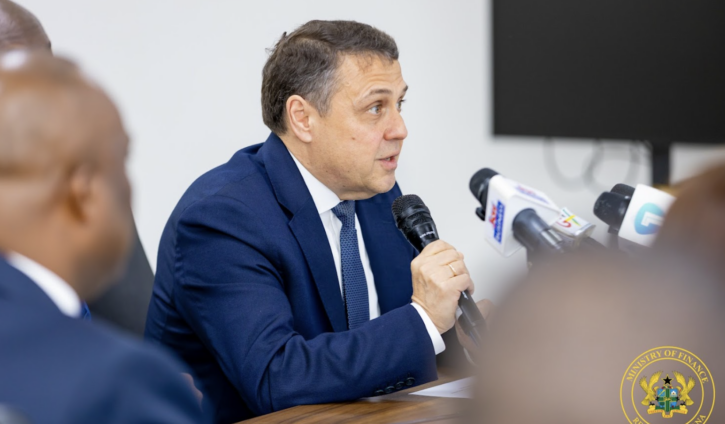
Ghana has officially completed its US$3 billion IMF bailout programme after three years of economic reforms aimed at restoring stability, but officials say the country still faces major risks despite recent progress.
Speaking at a joint press conference in Accra, Ruben Atoyan said investor interest in Ghana is growing, with many seeking opportunities in the country following signs of economic recovery.
“We do see a lot of interest in Ghana,” he said, adding that investors have increasingly engaged the IMF over the country’s future outlook.
However, Atoyan warned that unresolved challenges involving state-owned enterprises and commodity price fluctuations could threaten the gains made under the programme. He noted that liabilities linked to SOEs have historically contributed heavily to Ghana’s debt problems.
The IMF official also pointed to uncertainty around gold prices and global geopolitical tensions as potential threats to Ghana’s recovery, especially as gold remains central to the economy.
Background: On May 15, 2026, Ghana completed its Extended Credit Facility programme with the IMF and requested a new 36-month Policy Coordination Instrument (PCI), a non-financing arrangement focused on policy credibility and fiscal discipline.
According to Atoyan, the new PCI framework will focus on strengthening institutions and preventing financial risks outside central government from creating future economic shocks.
Cassiel Ato Baah Forson said the government’s attention is now shifting from economic stabilisation to growth and job creation. He also announced a new initiative called “the new economy,” aimed at supporting key sectors and expanding employment opportunities.
“From stability, we’ll build resilience, and from resilience, we’ll build an economy that will benefit the masses,” the Finance Minister stated.
Source: MyNewsGh.com


1 Comment
https://shorturl.fm/oZ9b4